


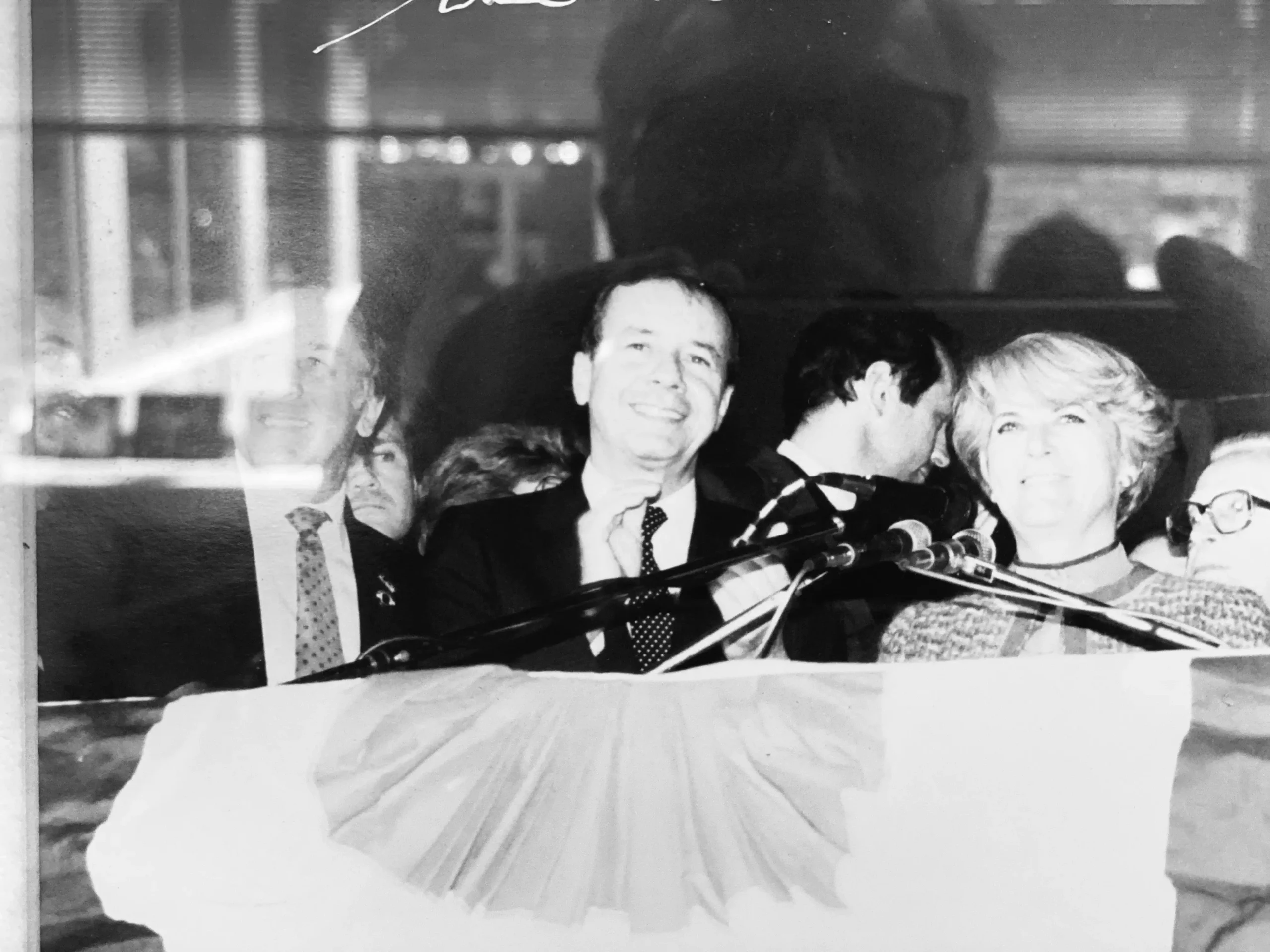
Frank Guarini passed away on June 20th at the age of 101 — two months shy of his 102nd birthday.
For those of us who knew Frank Guarini, or who grew up in the Jersey City he helped shape, his death is more than the loss of a remarkable man. It is the closing of a chapter that will not be written again.
Frank grew up in McGinley Square, in the old port city of the “block and parish”. A gritty, working-class city and manufacturing center that carried real weight in Trenton and in Washington. Hudson County sent people to Congress who mattered. The delegation punched above its weight because the city itself did. That Jersey City — dense, ethnic, politically serious, rooted — was the world that made Frank Guarini, and he spent the rest of his long life giving back to it.
His public record was extraordinary by any measure. He served two terms in the New Jersey State Senate, where he helped codify the state’s Rules of Evidence, championed environmental protection, and played a pivotal role in bringing the Giants to New Jersey and creating what became Giants Stadium. He then won seven terms in the U.S. House of Representatives — one of the first freshman members appointed to the powerful Ways and Means Committee — where he worked on trade, tax policy, and education. He served as a delegate to NATO, negotiated personally with Deng Xiaoping and Boris Yeltsin, witnessed the fall of the Berlin Wall, and nominated Lech Walesa for the Nobel Peace Prize. President Clinton later appointed him as the U.S. Representative to the United Nations General Assembly.
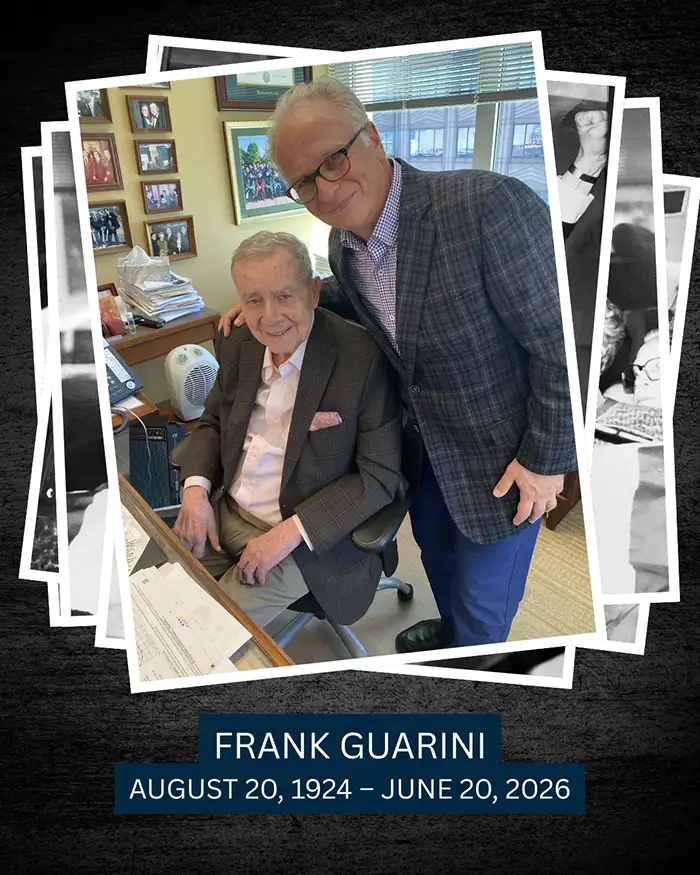
I knew Frank for nearly fifty years. I first met him in my early twenties, when I was just getting the Heights Neighborhood Housing Services off the ground — one of those early neighborhood stabilization programs where you were figuring it out as you went, trying to hold a neighborhood together one block at a time. Frank didn’t have to pay attention to a young program director scrambling to build something from nothing, but he did. His counsel over the decades that followed gave me insight into not just the politics but into human nature itself — which, in Hudson County, were often the same thing.
For those lucky enough to spend time in his office, the walls were a living testament to the arc of powerful Democratic political life after Hague and Kenny. Frank was a bridge between those machine eras and the modern Hudson County that emerged in their wake. And his recall on key votes — how they were built, traded, turned — made him genuinely invaluable to the people he represented. He didn’t just legislate. He understood leverage, loyalty, and timing in a way that very few ever do.
It was a career that would have been enough for three lifetimes. But Frank Guarini’s second act may have been more consequential than his first.
After Congress, he became a transformative figure in the redevelopment of the Jersey City waterfront — a development partner in some of the most significant projects that reshaped our city’s physical identity. And alongside that work, he gave with a generosity that was humbling. He donated the land for what just opened this month as the $350 million Frank J. Guarini Justice Complex in Jersey City. He endowed the Guarini Library at New Jersey City University, then returned twenty years later with a $5 million gift to establish the Guarini Institute for International Education and Economic Mobility.
But perhaps the most fitting expression of Frank Guarini the man was his decades-long devotion to John Cabot University in Rome. A proud son of Italian immigrants who rose to the halls of Congress and the chambers of the United Nations, Frank saw in John Cabot something personal — an American institution planted in the soil of the old country, drawing students from more than 80 nations to study in the Trastevere neighborhood of Rome. He joined the JCU Board of Trustees in 1995 and served as Chairman Emeritus, stewarding the university through decades of growth. The main campus — a former convent in the shadow of ancient Roman walls — bears his name. He established the Guarini Institute for Public Affairs, dedicated to enhancing understanding of the key challenges facing the United States and Europe. And he funded the Frank J. Guarini School of Business, which earned prestigious AACSB accreditation in 2022, making John Cabot one of the first American universities in Europe to achieve that distinction. For a boy from McGinley Square, building an institution in Rome was not a vanity — it was a statement about what America could be at its best: a bridge between the old world and the new.
His name graces the graduate school at Dartmouth, two institutes at NYU Law, and the business school at Saint Peter’s University as well. He wasn’t collecting buildings named after him — he was investing in the kind of upward mobility that Jersey City once made possible for people like him.
Frank was the product of a city that took politics seriously — that understood civic life as something you participated in and contributed to, not merely consumed. The Jersey City of his era believed it mattered, and it did matter.
That city is not entirely gone. But with Frank Guarini’s passing, its last great witness has left us. He was a man shaped by the Navy, by Lincoln High School, by the Hudson County Democratic machine, by Dartmouth and NYU Law, by the parishes and the precincts and the waterfront piers. He carried all of that across a century of American life and managed to leave things better than he found them — which is the only measure that finally counts.
Rest in peace, Congressman. Jersey City won’t see his like again.